



Organ Transplantation
The History of Transplanting
Kidney Transplants After heart Arrest
Establishing a Tranplant Network
The Enactment of the Organ Transplantation Law, and the revised Organ Transplant Act
Views on Brain Death
The Process Leading Up to an Organ Transplant
Current Issues Surrounding Transplants and Recipients
Donor Cards

is the only fundamental and radical treatment for patients with end-stage diseases of vital organs, which cannot be replaced by any other therapeutic modalities. Many patients die while waiting for such vital, life-saving organs to become available in Japan.

was enforced in Japan on October 16, 1997, legalizing
the transplantation of heart, lung, liver,pancreas, kidney and intestine
from brain-dead donors.
On July17, 2010, the revised Organ Transplant Act went into full
effect, under which rules regarding organ donation after brain
death were eased.

is designated in Japan as the irreversible functional loss of the entire brain, including the brain stem. The heart beat can be sustained temporarily with the support of a mechanical vetilator, but will eventually stop (in most cases, a few days). Brain death is estimated less than 1% of all deaths.

from a brain dead donor, under Japanese Law, was permitted
only when he/she (15 years old and over) had a documented will both
to accept the brain death diagnosis and to donate his/her organs
for organ transplantation, and also his/her family did not refuse
either of them.
However, after July 17, 2010, even if an individual's intention
is unclear, it has become possible to donate his/her organs under
family consent. Children under the age of 15 can also donate their
organs after brain death.

can be donated from non-heart beating cadavers, diagnosed based on the triad of the Japanese conventional death criteria (cardiac standstill, pulmonary arrest, and dilated pupils without light reflex), the former two organs irrespective of the existence of the documented will, the latter needs the documented will mandatorily.

will take several hours. There will be no additional costs associated with organ donation, and no payment will be made for the organs.

You can download English card here.
The content of Organ Donation Intention Declaration Card, or Organ
Donor Card, was changed in July 2010. Although the previous card
is valid, try and replace it with a new card as much as possible.
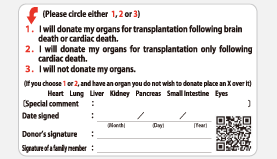
How to fill out your Organ Donation Decision
Card
Step 1:Select your intention
Circle just one number that matches your intention.
(a)Circle 1 if you wish to donate your organs, either after brain
death, or after cardiac death.
(b)Circle 2 if you do not want to donate organs after brain death
but wish to do so after cardiac death. (In this case, you will
not undergo legally-stipulated brain death diagnosis.)
(c)Circle 3 if you do not want to donate organs. (Go to Step 4.)
Step 2:Select any organ you do not want to donate.
If you chose 1 or 2, and have an organ you do not wish to donate,
place an X over the organ.
The organs you may donate include the following in each of the
two cases:
After brain death: Heart, Lung, Liver, Kidney, Pancreas, Small intestine, Eyes
After cardiac deathe: Kidney, Pancreas, Eyes
Step 3:Fill out the special comments column
(a)Donation of tissues
If you circled either 1 or 2, and may agree to donate tissues as well, such as the skin, cariac valves, blood vessels, bones, etc., you may write "All tissues" or individual tissues such as "skin", "cardiac valve", "blood vessel" or "bone".
(b)Intention of prioritizing family as a recipient
If you wish to declare your intention of prioritizing your family as a recipient, read this page, and write "Prioritize family".
Step 4:Sign your name, etc.
please sign your name and write the date of the signature yourself. If possible, have member of your family who know that you have this organ donor card, sign his/her name, to confirm the fact.